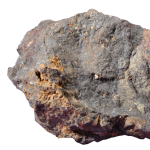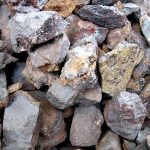

Incineration slag treatment is a complex process that involves handling highly heterogeneous materials. Unlike natural ores or construction aggregates, incineration slag contains a wide range of particle sizes, irregular shapes, residual metals, mineral fragments, and unburned residues. Effective classification at the early stages of processing is therefore essential for ensuring stable operation and high recovery efficiency throughout the entire treatment system.
Among various screening solutions, trommel screens have become one of the most widely adopted classification devices in incineration slag treatment plants. Their structural robustness, tolerance to harsh operating conditions, and ability to handle mixed materials make them particularly suitable for slag applications.
This article explores the role of trommel screens in incineration slag classification, explains why they are commonly selected over other screening options, and discusses how proper trommel screen configuration contributes to overall system performance.
Characteristics of Incineration Slag and the Need for Effective Classification
Incineration slag is fundamentally different from conventional mineral feed materials. Its composition and physical characteristics pose unique challenges for classification equipment.
Typical incineration slag exhibits the following features:
- A wide particle size distribution, ranging from fine ash-like particles to large solid blocks
- Irregular particle shapes, including angular fragments and elongated metal pieces
- Variable moisture content, depending on quenching methods and storage conditions
- The presence of unburned residues and lightweight contaminants
- Embedded ferrous and non-ferrous metals of varying sizes
Without effective size classification, downstream equipment such as crushers, magnetic separators, and gravity separation units may operate under unstable conditions. Oversized material can overload crushers, while excessive fines may reduce separation efficiency or increase wear.
As a result, reliable classification at the front end of the process is not optional—it is a foundational requirement for any incineration slag treatment system.
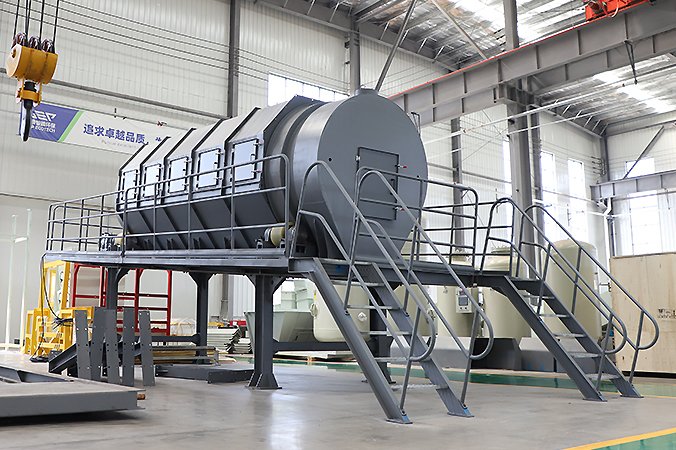
Working Principle of Trommel Screens in Slag Processing
A trommel screen consists of a rotating cylindrical drum fitted with perforated plates or mesh sections. As the drum rotates, material inside is continuously lifted and dropped. Finer particles pass through the screen openings, while coarser material progresses toward the discharge end.
This operating principle offers several advantages when applied to incineration slag:
- Continuous tumbling helps break up agglomerated material
- Rotation promotes self-cleaning of screen apertures
- Gentle material movement reduces the risk of clogging
- Large contact surface allows for efficient size separation
Unlike high-frequency vibrating screens, trommel screens rely on rotational motion rather than intense vibration. This makes them better suited for handling abrasive, mixed, and moisture-containing slag materials.
Key Functions of Trommel Screens in Incineration Slag Treatment Systems
1. Primary Size Classification
The most fundamental role of a trommel screen is to separate incineration slag into coarse and fine fractions. This initial classification allows subsequent processing stages to be tailored to specific particle size ranges.
Coarse fractions typically contain larger metal pieces and bulky mineral fragments, which may require crushing and further separation. Fine fractions, on the other hand, are often more suitable for magnetic separation, gravity separation, or direct dewatering.
By establishing a clear size boundary, trommel screens improve the effectiveness of all downstream processes.
2. Load Reduction for Downstream Equipment
Crushers, magnetic separators, and gravity separation equipment all have optimal feed size ranges. Feeding unclassified slag directly into these units can lead to reduced efficiency, increased wear, and higher maintenance requirements.
Trommel screens act as a protective buffer by removing oversized materials and regulating feed size. This load reduction contributes to:
- More stable operation of crushers
- Improved separation efficiency in magnetic and gravity units
- Lower power consumption
- Extended equipment service life
From an engineering perspective, this function alone often justifies the inclusion of a trommel screen in slag treatment systems.
3. Improvement of Metal Recovery Efficiency
Metal recovery performance is closely linked to feed uniformity. Magnetic separators and gravity separation devices operate more effectively when material size distribution is controlled.
By delivering a more consistent feed, trommel screens help:
- Increase ferrous metal recovery rates
- Reduce metal loss in fine mineral fractions
- Improve the purity of recovered metal products
In many slag treatment plants, trommel screens are installed upstream of multiple magnetic separation stages to maximize iron recovery.
4. Removal of Oversized Debris and Unburned Residues
Incineration slag often contains non-processable debris, such as oversized refractory pieces or unburned residues. Trommel screens allow such materials to be removed early in the process.
This early removal reduces the risk of blockages and mechanical damage further downstream and improves overall system reliability.
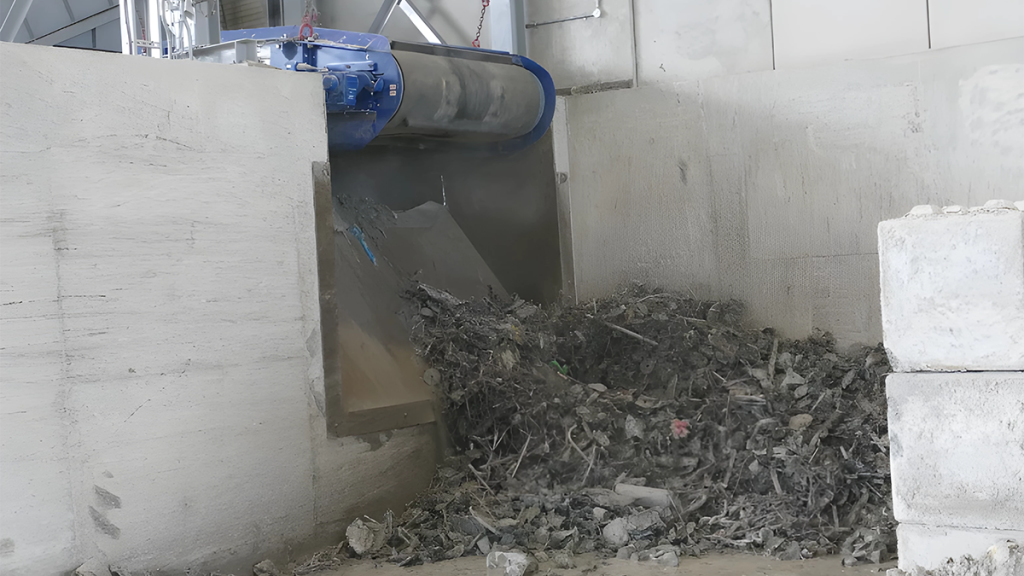
Trommel Screens vs. Vibrating Screens in Slag Applications
While vibrating screens are commonly used in aggregate processing, they are often less suitable for incineration slag.
Key differences include:
- Tolerance to moisture: Trommel screens perform better with wet or sticky materials
- Resistance to clogging: Rotational motion reduces blinding of screen openings
- Durability: Trommel screens are structurally robust for abrasive slag
- Feed variability: Trommel screens handle wide size variations more effectively
For these reasons, trommel screens are generally preferred in slag treatment systems, especially at the primary classification stage.
Engineering Considerations for Trommel Screen Selection
Proper selection and configuration of trommel screens is critical for achieving optimal performance.
Key factors include:
- Drum diameter and length
- Screen aperture size and segmentation
- Liner and wear-resistant materials
- Rotation speed and inclination angle
- Integration with upstream feeding and downstream conveying systems
Poorly selected trommel screens may limit system capacity or compromise separation efficiency. Therefore, trommel screen design should always be based on actual slag characteristics and project requirements.
Conclusion
Trommel screens play a central role in incineration slag treatment by providing reliable and effective size classification. Their ability to handle mixed, abrasive, and moisture-containing materials makes them particularly well-suited to slag applications.
Beyond individual equipment performance, successful slag treatment depends on how each processing step works together as part of a complete system. Stable classification improves metal recovery, protects downstream equipment, and supports consistent long-term operation.
With experience in incineration slag treatment applications, Forui focuses on practical and reliable system solutions. Through thoughtful process design, robust equipment supply, and on-site technical support, Forui helps ensure that slag treatment systems move smoothly from installation to stable, long-term operation.