
1. Manganese Resources and the Basis for Gravity Separation
Approximately 90% of the manganese produced worldwide (including ferromanganese, silicomanganese, metallic manganese, and high-grade manganese ore) is used in the steelmaking industry. The remaining portion is applied in light industry (such as dry batteries), as well as in chemical and agricultural sectors.
In practical production, manganese ores mainly occur in two forms: oxide manganese ore and carbonate manganese ore.
* Oxide manganese ore
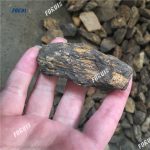
This type mainly includes pyrolusite and psilomelane, with a density generally ranging from 4,300 to 5,200 kg/m³. Such ores are commonly found in weathered or leached zones. They are typically loose in structure, have high clay content, and exhibit complex particle size distributions.
*Carbonate manganese ore
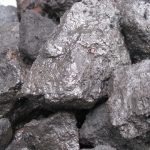
Represented by rhodochrosite, with a density of approximately 3,300 to 3,700 kg/m³. These ores are usually primary deposits, with oxide manganese zones often developed in the upper weathered section.
The significant density differences between manganese minerals and gangue minerals such as quartz and clay provide a solid physical basis for the application of gravity separation. Therefore, in manganese beneficiation, gravity separation is commonly introduced as the main upgrading method after washing and classification, and is often combined with magnetic separation or dense media separation.
2. Typical Oxide Manganese Ore Gravity Separation Example
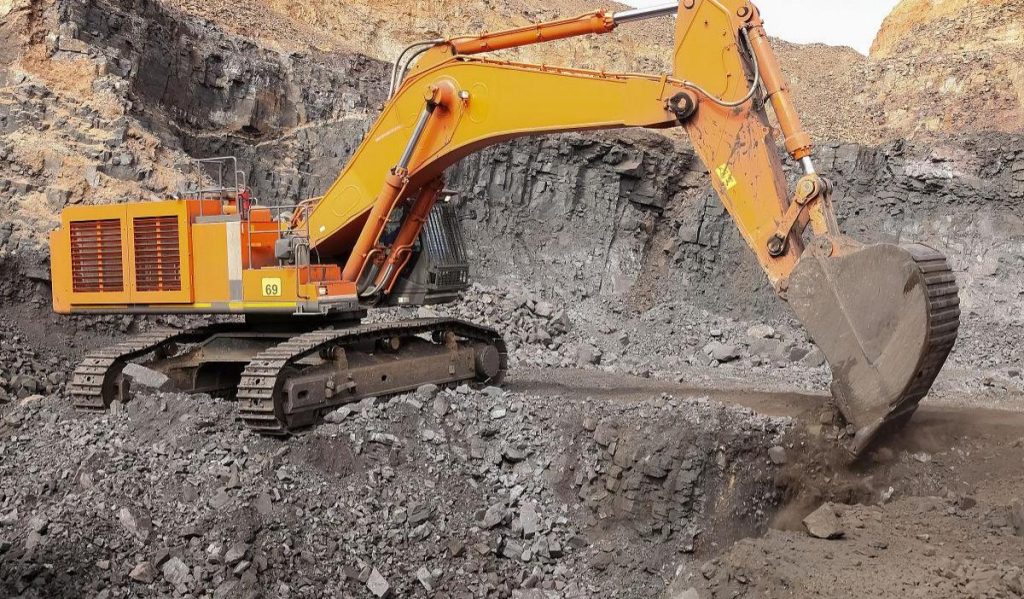
Taking a manganese mine in Fujian as an example, the ore is dominated by oxide manganese and is treated using a washing–screening–jigging–high-intensity magnetic separation flowsheet.
- After intensive washing and screening, the 30–3 mm size fraction is treated by an AM-30 coarse jig machine for preliminary upgrading;
- The jig tailings from the 30–3 mm fraction and the –3 mm fraction are ground to –1 mm in a rod mill;
- The ground product is then processed by a high-intensity magnetic separator to recover fine manganese minerals.
The overall performance indicators are as follows: Feed grade: 20.60% Mn; concentrate grade: 41.53% Mn; recovery: 78%.
This flowsheet demonstrates the role of jigging in the gravity separation of medium-size oxide manganese ore, while magnetic separation is used to recover fine particles and improve overall recovery.
3. Oxide Manganese Ore Gravity Separation Practices in Some Overseas Projects
In regions with favorable manganese resources, particularly where oxide manganese ores have relatively simple mineral structures, beneficiation flowsheets are still mainly based on washing and gravity separation.
Taking an oxide manganese mine in South Africa as an example, the adopted process includes:
- Hydrocyclones for desliming;
- Spiral washing machines (spiral gravity separators) for fine manganese ore separation.
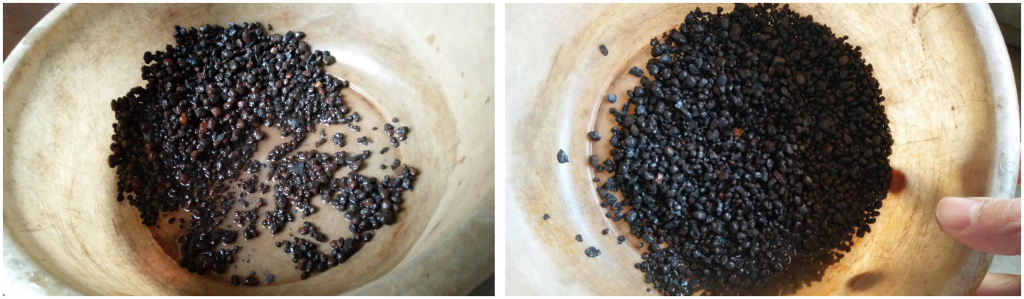
Through this process, a manganese concentrate containing approximately 40% MnO₂ is recovered from fine tailings with an initial MnO₂ content of about 20%, achieving effective reuse of tailings resources.
4. Overall Value of Gravity Separation in Manganese Beneficiation
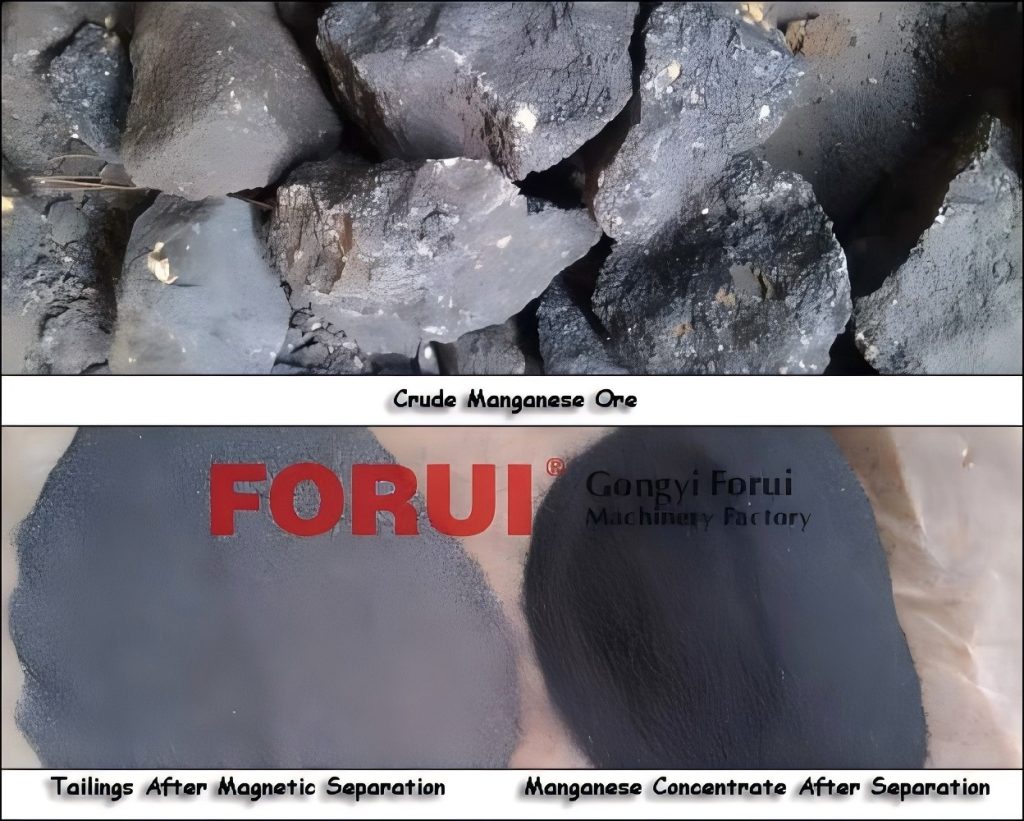
- Effective as a pre-concentration method, significantly reducing material volume before magnetic separation or smelting;
- Strong adaptability to ore characteristics, especially suitable for weathered and clay-rich manganese ores;
- Flexible process configuration, allowing combination with washing, magnetic separation, and dense media separation;
- Good economic performance, featuring low operating costs and relatively simple equipment maintenance.
In manganese beneficiation flowsheet design, the rational introduction of jigging, dense media separation, or other gravity separation equipment can improve concentrate grade and overall recovery without a significant increase in capital or operating costs.
5. Conclusion
As a company long focused on gravity beneficiation technology and equipment, Forui has accumulated extensive engineering experience in manganese ore processing. Based on ore characteristics, Forui is able to provide targeted equipment selection and technical support to help manganese beneficiation projects achieve stable and efficient operating results.